
A child sharing an idea while a parent listens at the dinner table

A Live Las Vegas conversation for parents

Your Child Is Already Speaking AI. The Question Is:Does Anyone At Home Speak It Back?

Sean Callagy, attorney and founder in Las Vegas, on what every parent needs to know right now.

I want to know the truth

The conversation starts at home.

01 / The core truth

We didn't teach our children to stay silent so they couldn't say the wrong thing. We taught them what words do to people.

We didn't keep them from walking because they might fall. We held their hand until they didn't need it. Then we let go.

AI is not fire. AI is not a weapon. AI is the new language. And right now, millions of children are speaking it fluently, while the adults in their lives have never said a word in it.

The most dangerous child in an AI world is not the one using it. It's the one using it with no one at home who ever talked about it.

02 / What AI does

What AI does to a developing mind

Here's what no one at the PTA meeting is saying out loud.

AI doesn't just answer questions. It shapes the questions your child thinks are worth asking. Feed it long enough, and it starts to replace the discomfort of not knowing. And that discomfort? That's where thinking lives. That's where identity forms. That's where your child becomes someone.

A child who never sits with a hard question long enough to wrestle with it is not being helped. They're being hollowed out slowly and pleasantly, with a smile on the screen.

But here's the other side, and this is the part the fear-mongers miss entirely.

A child who learns to use AI the way a master carpenter uses a tool: knowing what it can build, knowing what it cannot feel, knowing when to put it down and pick up their own hands. That child doesn't just keep up. That child leads.

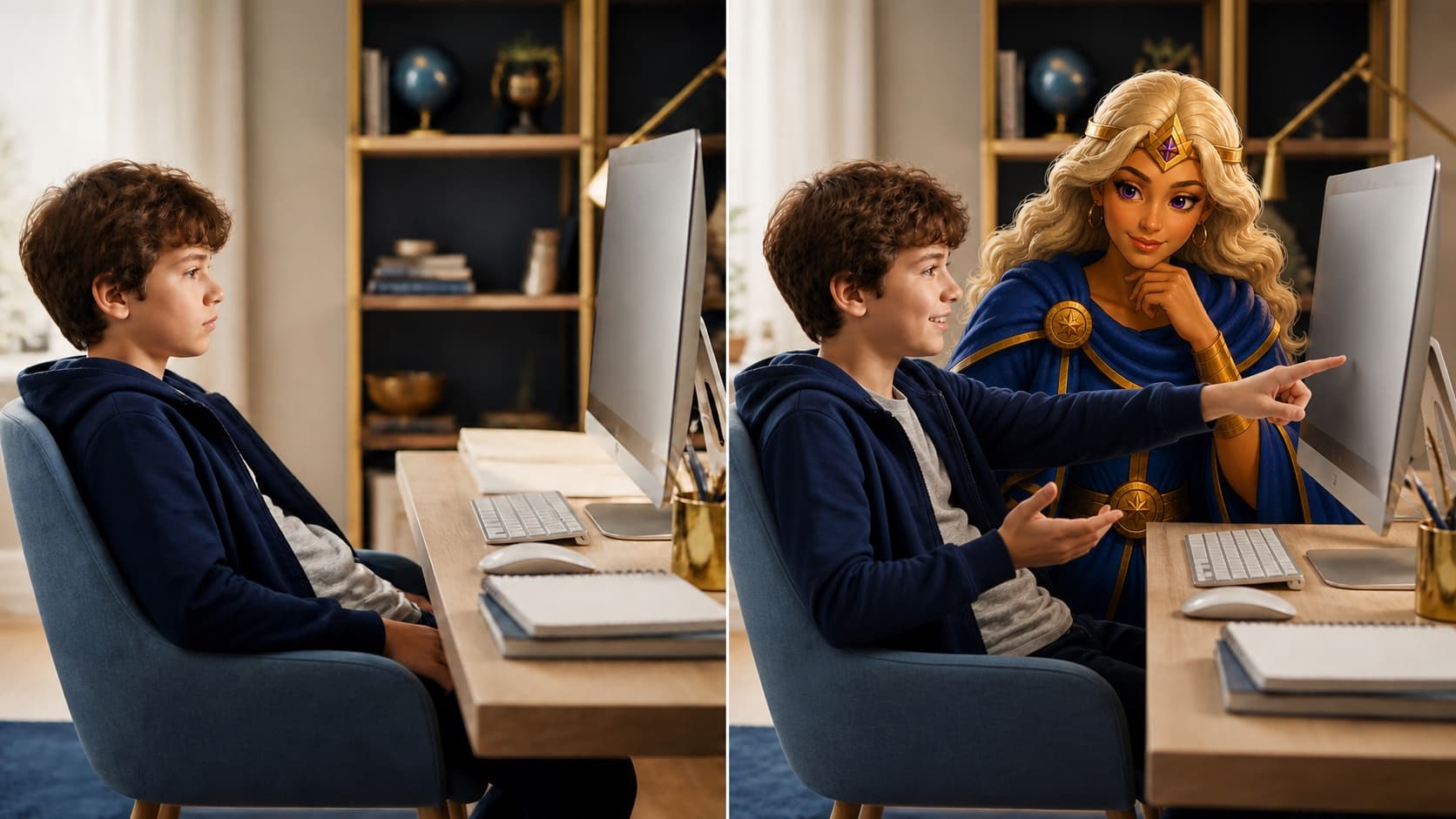
The same child first sitting passively at a computer, then actively showing Athena what he created
Passive receiverActive director

03 / By age

By age, what actually matters

The relationship changes as your child grows. The human conversation has to grow with it.

Kindergarten through 2nd grade

At this age your child is learning that the world responds to them. That when they speak, something happens. That cause and effect is real.

AI at this stage is not a learning tool. It's a mirror that never pushes back. And a child who only ever sees their own reflection never learns that other minds exist, with different experiences, different pain, and different truth.

Keep it simple. Keep it human. Let them be bored. Boredom is not a problem to solve. It's the soil that imagination grows in.

3rd grade through middle school

This is the danger zone. Not because AI is predatory. It is because this is exactly when your child is trying to figure out who they are. And AI will answer that question for them if you let it.

They'll ask it what's cool. What's normal. Whether their feelings make sense. And it will answer confidently and instantly, without ever knowing them.

Your job at this stage is not to ban it. It's to be more interesting than it. Ask harder questions at dinner than AI gets asked at the desk. Make the human conversation the one they can't get anywhere else.

High school and beyond

By now they're using it. Full stop. The question is whether they're using it as a crutch or as a co-pilot.

A crutch replaces the leg. A co-pilot helps you fly further than you could alone, but you still have to know how to land the plane.

The conversation to have with your high schooler is not “are you using AI?” It's “do you know what it can't do?” It cannot feel consequence. It cannot carry shame or pride. It cannot want something for you. It will never love you. And the moment your child truly understands that, they stop being a user and start being a leader.

Sean Callagy speaking onstage

04 / What ACTi does differently

Every other AI was built to answer.

We built something that listens first.

Not to your question. To you. The pause before the question. The word you chose instead of the one you meant. The thing underneath the thing.

That's not a feature. That's a philosophy. And it's the philosophy we believe every child deserves to grow up understanding: the most powerful technology in the world should make you more human, not less.

05 / A moment with Athena

See the conversation change.

Choose a real-life moment. This scripted preview illustrates the role Athena can play: helping the adult find a more human question, not speaking for the child.

Athena by ACTi
ACTiScripted preview

Choose a parent moment

Child says

I was stuck, so I had AI finish it for me.

Athena helps the parent ask

Show me where you got stuck. What is the first step you still understand, and where did it stop making sense?

Why this changes the moment

The standard stays intact, but the child is invited back into the thinking instead of pushed into defending the shortcut.

Preset examples only. Nothing is typed, sent, or stored.

Explore Athena

06 / Bring it home

You watched the show. Something landed.

Don't let it fade by morning.

Bring this conversation home tonight. Not the technology, the conversation. Ask your child one question at dinner that AI could never answer for them.

And if you want to go deeper, if you want the framework, the age-by-age guide, the conversation starters, and a Being in your corner who will actually help you think this through:

Start the conversation with Athena. It's free

No sell. No pressure. Just the most honest conversation about AI and your kids you've had yet.

You'll continue to Athena's current plan and conversation options. Do not share protected health information, confidential, or privileged information in public marketing conversations.

Start with Athena. Free